
Strength Training Through a Marathon Cycle


As fall marathon season sneaks up on us, long runs get longer, weekly mileage continues to climb, and overall training volume is increasingly revolving around running.
With all of the added mileage, strength training often becomes less consistent, and that is not necessarily a bad thing. I do not train the same way in October that I do in June, and I do not think marathon runners should either.
My approach shifts strength training alongside running volume, moving from heavier, capacity-building work early in the cycle to lighter, maintenance-focused sessions as race day approaches.
Here is how I structure strength training through a marathon build, specifically looking at my recent Chicago Marathon training, and the clinical reasoning behind each phase.
Key Takeaways
- Heavy, Low-Rep Drives Adaptation: In the off-season and base phases, lift 4 to 5 sets of 4 to 6 reps with heavy weight. High-rep, light-weight circuits do not trigger the neuromuscular recruitment runners need.
- Five Foundational Patterns: Structure sessions around Push, Pull, Hinge, Squat, and Carry to support joint mechanics without excess fatigue.
- Stack Stress on Hard Days: Lift after workouts or speed days to keep recovery and easy run days genuinely restorative.
- Taper, Do Not Abandon: Dial volume down during peak mileage and taper weeks to prioritize running economy and preserve tissue resilience.
1. Off-Season & Early Base Training: Build Strength with Heavy, Low-Rep Work
Just like you build your aerobic base before your marathon block, you should be building a strength base in your off-season.
For me, this was the roughly six weeks coming off an ultra relay, when my running volume was relatively low and I had more recovery capacity to dedicate to the gym floor.
While your running mileage is still low, this is the prime window to develop real musculoskeletal strength and tendon stiffness.
Why Heavy Weights Beat High Reps for Runners
A common misconception among endurance athletes is that lifting light weights for 15 to 25 repetitions builds "muscular endurance" for running. Science and physiology demonstrate the opposite.
Clinical research comparing heavy/low-rep lifting, light/high-rep lifting, and complex training (heavy lifts paired with plyometrics) in recreational runners found that the heavy and complex protocols produced meaningful neuromuscular gains and running economy improvements. Conversely, the light-weight, high-rep group showed no measurable strength improvement, even with overall training load matched across groups (Li et al., 2021).
In other words, heavier weight and fewer repetitions are what actually drive neural adaptations without inducing excessive muscle hypertrophy or chronic fatigue.
Off-Season Strength Guidelines
- Frequency: 2 to 3 sessions per week
- Volume: 4 to 5 sets of 4 to 6 reps (challenging, heavy load at RPE 8 to 9)
- Movement Selection: Focus on compound, full-body movements:
- Squat: Goblet squats, front squats, or rear-foot elevated split squats
- Hinge: Barbell Romanian deadlifts or trap bar deadlifts
- Pull: Weighted pull-ups or heavy barbell rows
- Push: Overhead kettlebell press or dumbbell bench press
- Carry: Single-arm suitcase carries or heavy farmer walks
To keep it simple: one exercise each from the push, pull, hinge, squat, and carry categories covers what runners actually need. Off-season is also the ideal time to rebuild structural resilience if you are coming off a high-volume block where running fitness was prioritized at the expense of everything else.
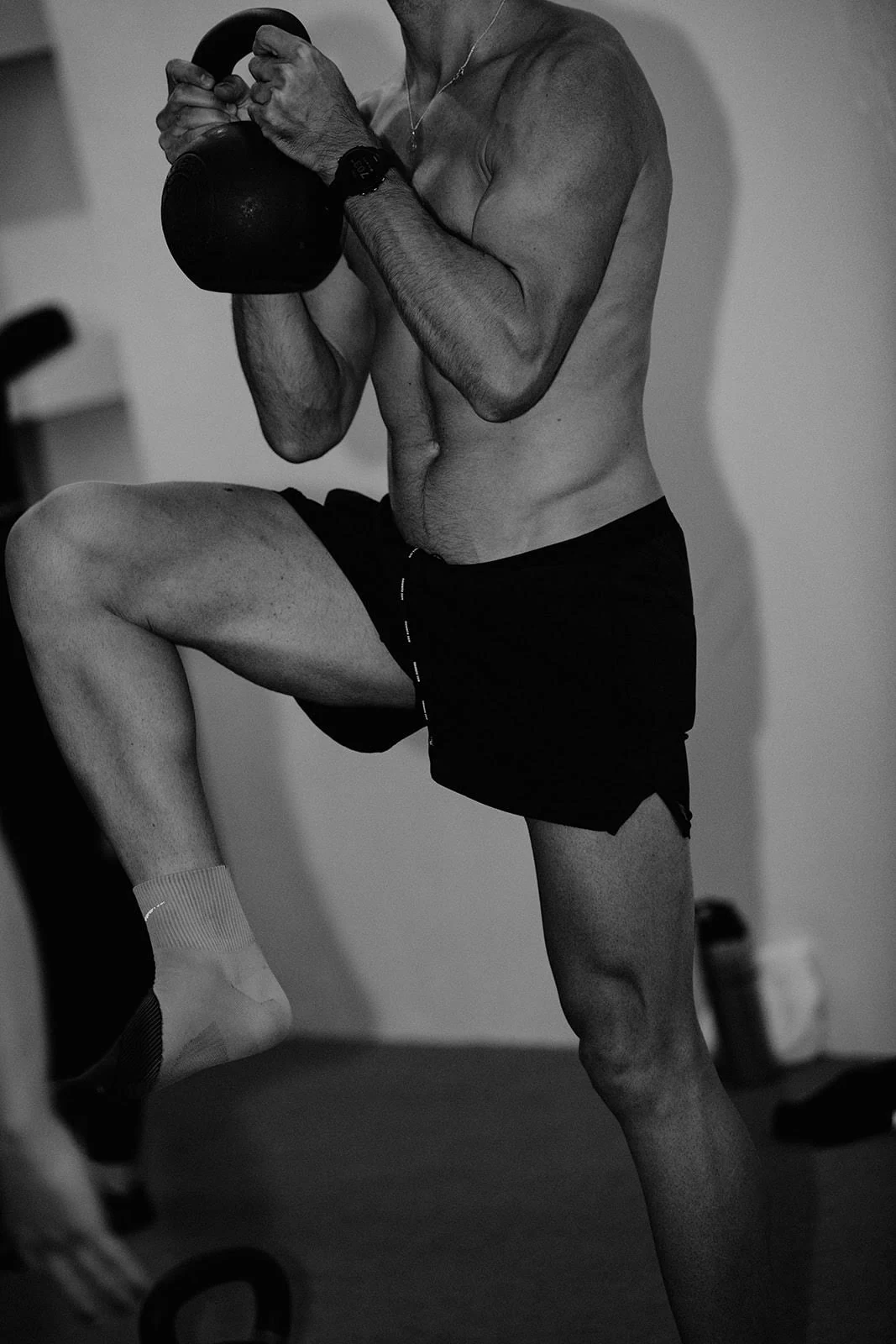
2. Mid-Cycle: Maintain Strength as Running Volume Increases
As weekly mileage ramps up and running becomes the primary training stress, the focus for strength work shifts from building new capacity to maintaining what you have built.
Two sessions per week are usually enough.
In this phase, keep the same foundational movement patterns, but reduce the overall set volume and adjust the rep range slightly (e.g., 2 to 3 sets of 6 to 8 reps).

How to Schedule Lifts: "Hard Days Hard"
The biggest mistake runners make mid-cycle is placing strength sessions on their rest days. Doing so turns every day into a stress day, compromising recovery and increasing injury risk.
Instead, pair your strength sessions with hard workout or speed days:
- Run your workout or interval session in the morning.
- Complete your lifting session later that afternoon or evening.
- Keep your easy running days and rest days truly restorative.
Strength requires a consistent stimulus to stick around throughout a 16-to-18 week marathon block. Dropping strength training entirely once mileage builds means giving back the valuable gains you made early in the cycle. The goal here is not setting personal records in the weight room; it is preserving the tissue armor you built.
3. Late Training & Taper: Prioritize Run Demands & Preserve Resilience
As peak long runs arrive (18 to 22 miles) and marathon-specific workouts become demanding, strength training takes another step back.
This is not about eliminating strength work, but about reallocating your body’s finite energy and recovery reserves toward the runs that directly prepare you for race day.

As your training progresses, your runs themselves do the heavy lifting:
- Long runs include extended marathon-pace segments.
- Interval workouts become longer and more race-specific.
- Sleep, nutrition, and autonomic recovery become paramount.
Running becomes the dominant demand your body has to organize itself around. Strength training does not disappear, but it occupies less real estate during the week.
At this stage, lifting exists purely to preserve tissue resilience and movement quality, not to build new capacity. Aim for 1 to 2 brief sessions per week of 2 sets per movement, prioritizing clean movement, nervous system priming, and mobility.
Summary: The Takeaway
Strength training across a marathon cycle should mirror the run training itself: periodized, not static.
- Heavy and frequent when mileage is low and base capacity is being formed.
- Steady and controlled as weekly running volume builds through the mid-block.
- Lighter but consistent as peak long runs and the race taper approach.
When you treat strength training this way, it directly supports the build instead of competing with it.
Frequently Asked Questions
Should marathon runners stop lifting during race week?
During race week, you should not perform heavy or fatiguing strength training. A light session 4 to 5 days before the race focused on mobility, light plyometrics, and neural activation can help keep your neuromuscular system sharp without creating soreness or glycogen depletion.
Does heavy lifting make marathoners too bulky?
No. Gaining significant muscle mass (hypertrophy) requires both a caloric surplus and high training volume in the 8 to 12 rep range near failure. Heavy lifting at 4 to 6 reps primarily stimulates neuromuscular recruitment and tendon stiffness, making you more economical per stride without adding unnecessary body mass.
Can I do bodyweight exercises instead of lifting heavy?
While bodyweight exercises like lunges and push-ups are useful for general movement, they do not produce the high-threshold motor unit recruitment or tendon adaptations required to maximize running economy and shield joints from repetitive impact forces.
Scientific Citations
- Li F, Nassis GP, Shi Y, Han G, Zhang X, Gao B, Ding H. Concurrent complex and endurance training for recreational marathon runners: Effects on neuromuscular and running performance. European Journal of Sport Science. 2021 Sep;21(9):1243-1253. doi: 10.1080/17461391.2020.1829080. PMID: 32981468.
Not sure how to structure your strength sessions around your marathon build? Schedule an evaluation with Dr. Meredith Mottern or explore our Run Coaching & Gait Analysis services.

Meredith is a Physical Therapist who is passionate about helping athletes and active individuals return to the activities they love with confidence.
Keep Reading
Related Articles

Building Achilles Tendon Stiffness & Durability
Is there such a thing as offseason for runners? Most are in the sport for the love of motion, or easily quantifiable health benefits. As such, it’s not...

Hallux Rigidus: How Your Big Toe Affects All Movement
Your big toe may seem small and inconsequential, but is actually the basis and foundation of all movement.

Can Exercise in Cold Weather Cause An Injury? What the Research Says
MOTIVNY's annual polar plunge is not only an event that showcases the bravest of the brave (or craziest), but also a showcase of the depth of our winter...